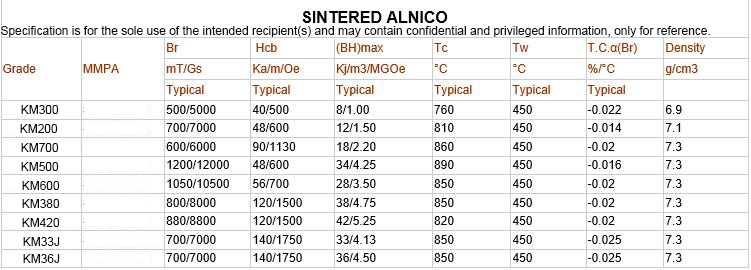
Sintered alnico magnet:
Alnico magnets are produced by?casting?or?sintering?processes.[8]?Anisotropic alnico magnets are oriented by heating above a critical temperature and cooling in the presence of a magnetic field. Both isotropic and anisotropic alnico require proper heat treatment to develop optimal magnetic properties—without it alnico’s coercivity is about 10?Oe, comparable to technical iron, which is a soft magnetic material. After the heat treatment alnico becomes a composite material, named “precipitation?material”—it consists of iron- and cobalt-rich[9]?precipitates in rich-NiAl matrix.
Alnico’s anisotropy is oriented along the desired magnetic axis by applying an external magnetic field to it during the precipitate particle nucleation, which occurs when cooling from 900?°C (1,650?°F) to 800?°C (1,470?°F), near the?Curie point. Without an external field there are local anisotropies of different orientations due to spontaneous magnetization. The precipitate structure is a “barrier” against magnetization changes, as it prefers few magnetization states requiring much energy to get the material into any intermediate state. Also, a weak magnetic field shifts the magnetization of the matrix phase only and is reversible.